 Jito
Jito Staking mints JitoSOL directly from SOL without DEX swap slippage
Updated:
Jito Staking lets a Solana wallet deposit spendable SOL into the Jito stake pool and receive newly minted JitoSOL at the pool’s on-chain exchange rate. This direct route avoids DEX price impact and slippage settings because no market swap determines the output. The wallet still needs SOL for the deposit and network fees, while the amount of JitoSOL received will generally differ from the SOL amount as accumulated rewards change the exchange rate.
Rewards change the pool exchange rate after minting
Directly minted JitoSOL represents a share of pooled SOL whose exchange rate incorporates rewards earned by the underlying stake.
Solana staking rewards come from validator delegation, while MEV-related tips come from transaction-ordering activity. Neither stream arrives as a recurring transfer to each wallet. The pool accounts for both in the value backing JitoSOL after applicable validator commissions and protocol fees.
JitoSOL rewards accrue through the pool exchange rate rather than through recurring token distributions to each wallet. The token count can remain unchanged while its value measured in SOL moves.
Comparing token counts alone misses the reward mechanism because a later wallet balance may look unchanged. A quoted annual yield also cannot determine the mint output; the on-chain pool rate at execution does that job.
Neither reward source has a fixed rate. Validator performance, commissions, Solana issuance and MEV activity can change the amount entering the pool. The exchange rate records the value relevant to a specific mint, while an annualized figure only summarizes a period and may not persist.
Direct mint and market purchase solve different entry needs
Direct minting creates JitoSOL, while a market purchase transfers existing JitoSOL to the wallet. The two routes determine output through different mechanisms.
A direct SOL deposit mints JitoSOL through the Solana Program Library stake pool without using a DEX order or liquidity route. The program uses the pool exchange rate, so liquidity depth, routing and swap tolerance do not set the minted amount.
A market purchase depends on available liquidity and can return a different amount after price impact, route fees and spread. Its market price can trade above or below the pool exchange value. This route may still fit when the input asset is not SOL or when its final quote is preferable.
Spendable SOL can enter direct mint, while another SPL token needs a swap and an existing delegated stake account uses a separate deposit process. Compare the displayed JitoSOL output and total SOL cost on equal terms rather than comparing route labels.
Direct mint relies on the stake-pool program and Solana confirmation. A market purchase adds the selected routing program and liquidity venues. Both need wallet authorization, but only the market route needs a swap tolerance for movement between its quoted and minimum accepted output.
How much JitoSOL does a direct SOL deposit mint?
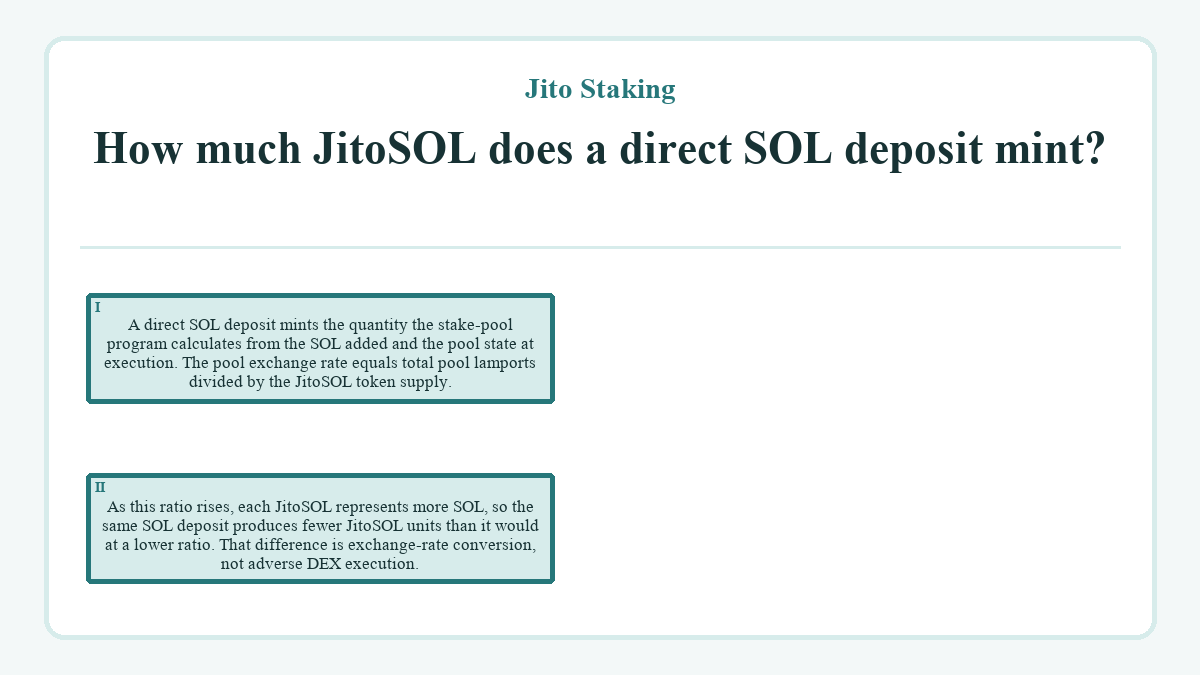
A direct SOL deposit mints the quantity the stake-pool program calculates from the SOL added and the pool state at execution. The pool exchange rate equals total pool lamports divided by the JitoSOL token supply. As this ratio rises, each JitoSOL represents more SOL, so the same SOL deposit produces fewer JitoSOL units than it would at a lower ratio. That difference is exchange-rate conversion, not adverse DEX execution.
The interface preview is the practical checkpoint. Confirm the SOL amount leaving the wallet, the expected JitoSOL amount and the network charges before signing. Judge the output against the displayed pool rate, not an assumed one-for-one conversion. A material mismatch calls for a refreshed quote before approval.
A direct-mint readiness and confirmation checklist
Direct mint fits when the input, wallet and desired settlement all match the stake-pool route. Check each condition before authorizing the transaction.
- Start with spendable SOL. A delegated stake account and another SPL token each require a different route.
- Use a Solana wallet capable of signing the transaction and displaying standard SPL tokens such as JitoSOL.
- Leave enough SOL outside the deposit to cover network fees and any token-account creation required by the wallet.
- Read the preview as an exchange-rate conversion, then compare the expected JitoSOL with the SOL the transaction will spend.
- Approve only the intended account, amount and network; a wallet connection alone does not authorize a deposit.
- Count a confirmed signature plus the JitoSOL balance as completion. If status is failed or expired, verify that state before retrying.
Wallet balance and pool value answer different questions
The JitoSOL balance records how many pool tokens the wallet owns, while the exchange rate expresses their underlying SOL value.
Rewards normally change the second figure rather than minting extra JitoSOL into the wallet. Multiplying the token balance by the current pool rate estimates the position in SOL terms, before considering any separate application. A fiat display adds another moving variable because the market price of SOL also changes.
Moving JitoSOL into a compatible DeFi application changes where the position appears, not how the pool token carries its staking exposure. A wallet-based rewards view may omit tokens held inside another program. Track the application position and the JitoSOL rate separately, including any added fees, liquidation rules or withdrawal conditions.
Does no-slippage minting mean the conversion is free?
No. Avoiding DEX slippage removes a market-execution cost, not Solana network charges or deductions from staking rewards.
Every Solana transaction needs a fee payer with SOL. Network charges can include a base transaction fee and an optional priority component selected by the submitted transaction. They vary independently of DEX slippage, and an executed transaction can consume its fee even if it fails.
Validator commissions and protocol reward fees belong to the yield calculation, not DEX execution. They affect the net rewards incorporated into the exchange rate. Keep these cost categories separate: the transaction’s network fee, pool-level deductions from rewards and market slippage only when a swap route is used.
Existing stake accounts use a different conversion path
A native stake account does not enter the same direct-mint path as spendable SOL, even though both represent value on Solana.
Existing stake-account deposits pass through the Interceptor, which holds the minted JitoSOL for a 10-hour cooldown before automatic delivery. Waiting through that period avoids the optional early-claim fee, which decays as the cooldown progresses.
A wallet holding delegated stake must select the stake-account conversion route, while a wallet holding liquid SOL can use direct mint. Active and inactive stake accounts can enter the conversion process, but the Interceptor timing still separates their delivery from a regular SOL deposit.
Entry without swap slippage does not fix the later exit cost
Minting through the pool does not force one exit route, and the original no-slippage entry promise does not govern a later sale.
JitoSOL can move or trade without deactivating the underlying pooled stake. A market sale settles through available DEX liquidity and may incur spread or price impact. Direct unstaking follows the stake-pool withdrawal process and Solana stake deactivation; it avoids market slippage but introduces a protocol fee and an epoch-based wait before SOL becomes spendable.
Direct mint fits when the input is spendable SOL and pool-rate execution matters most. A market purchase may fit when another input asset or its final quote changes the trade-off. At exit, compare the direct route’s delay and fee with the market route’s liquidity costs instead of assuming the entry route determines the choice.
Jito Staking: quick answers
-
Can a multisignature wallet direct-mint JitoSOL?
- A multisignature wallet can direct-mint JitoSOL if it supports Solana transactions, SPL token accounts and the stake-pool instruction. The proposal must collect the required approvals before submission, and its fee payer needs SOL. Review the destination token account as well as the deposit amount because JitoSOL must return to the intended multisignature-controlled account. A hardware signer or custody policy may add approval steps, but neither changes the pool rate used at execution.
-
Does direct minting require choosing a validator?
- Direct minting does not ask the depositor to choose a validator. The Jito stake pool allocates underlying SOL across validators through its pool management system, while the wallet receives JitoSOL representing a proportional pool share. Native delegation retains direct validator selection at the stake-account level, while eligible large JitoSOL holders and whitelisted DeFi protocols can use the pool’s separate directed staking program. Pool allocation can change later as the validator set rebalances, without another action from the JitoSOL holder.
-
How can I identify the genuine JitoSOL mint after staking?
- Match the token against the Mainnet JitoSOL mint address: J1toso1uCk3RLmjorhTtrVwY9HJ7X8V9yYac6Y7kGCPn. A copied token name or symbol is not sufficient because unrelated tokens can reuse display metadata. Check the mint before interacting with an unfamiliar wallet entry, swap quote or token account. This identifier applies to Mainnet and Testnet, while Devnet uses a different JitoSOL mint, so network selection remains part of the check.
-
Will a failed direct-mint transaction move my SOL into the pool?
- A failed Solana transaction does not commit the deposit or the JitoSOL mint because its instructions execute atomically. The network fee can still be charged for an executed failure. Check the transaction status before resubmitting; if the signature later confirms, a duplicate submission could create a second valid deposit. A wallet simulation rejection may stop submission before an on-chain fee applies. A charged fee alone does not prove the deposit succeeded.
-
Does minting JitoSOL also create JTO voting power?
- Minting JitoSOL does not create JTO or its governance rights. JitoSOL represents a share of SOL held and delegated through the stake pool, with rewards reflected in the pool exchange rate. JTO is a separate governance token. Holding one asset does not automatically issue, convert into or confer the rights attached to the other. Acquiring JTO would be a separate transaction with its own market and custody considerations.